
IoT Standards and Protocols
An overview of protocols involved in Internet of Things devices and applications. Help clarify with IoT layer technology stack and head-to-head comparisons.
The Internet of Things covers a huge range of industries and use cases that scale from a single constrained device up to massive cross-platform deployments of embedded technologies and cloud systems connecting in real-time.
Tying it all together are numerous legacy and emerging communication protocols that allow devices and servers to talk to each other in new, more interconnected ways.
At the same time, dozens of alliances and coalitions are forming in hopes of unifying the fractured and organic IoT landscape.
The following Channel Guide:
- Provides overview list of popular protocols and standards helping power IoT devices, apps and applications
- Drill down on specific layers or industry specific protocols
- List head-to-head comparisons of popular protocols (ie: mqtt vs xmpp)
01/02/2020

Protocols
Rather than trying to fit all of the IoT Protocols on top of existing architecture models like OSI Model, we have broken the protocols into the following layers to provide some level of organization:
- Infrastructure (ex: 6LowPAN, IPv4/IPv6, RPL)
- Identification (ex: EPC, uCode, IPv6, URIs)
- Comms / Transport (ex: Wifi, Bluetooth, LPWAN)
- Discovery (ex: Physical Web, mDNS, DNS-SD)
- Data Protocols (ex: MQTT, CoAP, AMQP, Websocket, Node)
- Device Management (ex: TR-069, OMA-DM)
- Semantic (ex: JSON-LD, Web Thing Model)
- Multi-layer Frameworks (ex: Alljoyn, IoTivity, Weave, Homekit)
Security
Industry Vertical (Connected Home, Industrial, etc)
Infrastructure
IPv6 - "IPv6, is an Internet Layer protocol for packet-switched internetworking and provides end-to-end datagram transmission across multiple IP networks.
6LoWPAN - "6LoWPAN is an acronym of IPv6 over Low power Wireless Personal Area Networks. It is an adaption layer for IPv6 over IEEE802.15.4 links. This protocol operates only in the 2.4 GHz frequency range with 250 kbps transfer rate."
UDP (User Datagram Protocol) - A simple OSI transport layer protocol for client/server network applications based on Internet Protocol (IP). UDP is the main alternative to TCP and one of the oldest network protocols in existence, introduced in 1980. UDP is often used in applications specially tuned for real-time performance.
- QUIC (Quick UDP Internet Connections, pronounced quick) supports a set of multiplexed connections between two endpoints over User Datagram Protocol (UDP), and was designed to provide security protection equivalent to TLS/SSL, along with reduced connection and transport latency, and bandwidth estimation in each direction to avoid congestion.
- Aeron - Efficient reliable UDP unicast, UDP multicast, and IPC message transport.
uIP - The uIP is an open source TCP/IP stack capable of being used with tiny 8- and 16-bit microcontrollers. It was initially developed by Adam Dunkels of the "Networked Embedded Systems" group at the Swedish Institute of Computer Science, licensed under a BSD style license, and further developed by a wide group of developers.
DTLS (Datagram Transport Layer) - "The DTLS protocol provides communications privacy for datagram protocols. The protocol allows client/server applications to communicate in a way that is designed to prevent eavesdropping, tampering, or message forgery. The DTLS protocol is based on the Transport Layer Security (TLS) protocol and provides equivalent security guarantees."
ROLL / RPL (IPv6 routing for low power/lossy networks)
NanoIP
"NanoIP, which stands for the nano Internet Protocol, is a concept that was created to bring Internet-like networking services to embedded and sensor devices, without the overhead of TCP/IP. NanoIP was designed with minimal overheads, wireless networking, and local addressing in mind."
Content-Centric Networking (CCN) - Technical Overview
"Next-gen network architecture to solve challenges in content distribution scalability, mobility, and security.
CCN directly routes and delivers named pieces of content at the packet level of the network, enabling automatic and application-neutral caching in memory wherever it’s located in the network. The result? Efficient and effective delivery of content wherever and whenever it is needed. Since the architecture enables these caching effects as an automatic side effect of packet delivery, memory can be used without building expensive application-level caching services."
Time Synchronized Mesh Protocol (TSMP)
A communications protocol for self-organizing networks of wireless devices called motes. TSMP devices stay synchronized to each other and communicate in timeslots, similar to other TDM (time-division multiplexing) systems.
Discovery
mDNS (multicast Domain Name System) - Resolves host names to IP addresses within small networks that do not include a local name server.
Physical Web - The Physical Web enables you to see a list of URLs being broadcast by objects in the environment around you with a Bluetooth Low Energy (BLE) beacon.
HyperCat - An open, lightweight JSON-based hypermedia catalogue format for exposing collections of URIs.
UPnP (Universal Plug and Play) - Now managed by the Open Connectivity Foundation is a set of networking protocols that permits networked devices to seamlessly discover each other's presence on the network and establish functional network services for data sharing, communications, and entertainment.
Data Protocols
MQTT (Message Queuing Telemetry Transport)
"The MQTT protocol enables a publish/subscribe messaging model in an extremely lightweight way. It is useful for connections with remote locations where a small code footprint is required and/or network bandwidth is at a premium."
-Additional resources
MQTT-SN (MQTT For Sensor Networks) - An open and lightweight publish/subscribe protocol designed specifically for machine-to-machine and mobile applications
-Mosquitto: An Open Source MQTT v3.1 Broker
- IBM MessageSight
CoAP (Constrained Application Protocol)
"CoAP is an application layer protocol that is intended for use in resource-constrained internet devices, such as WSN nodes. CoAP is designed to easily translate to HTTP for simplified integration with the web, while also meeting specialized requirements such as multicast support, very low overhead, and simplicity. The CoRE group has proposed the following features for CoAP: RESTful protocol design minimizing the complexity of mapping with HTTP, Low header overhead and parsing complexity, URI and content-type support, Support for the discovery of resources provided by known CoAP services. Simple subscription for a resource, and resulting push notifications, Simple caching based on max-age."
-Additional resources
- SMCP — A C-based CoAP stack which is suitable for embedded environments. Features include: Support draft-ietf-core-coap-13, Fully asynchronous I/O, Supports both BSD sockets and UIP.
STOMP - The Simple Text Oriented Messaging Protocol
XMPP (Extensible Messaging and Presence Protocol)
"An open technology for real-time communication, which powers a wide range of applications including instant messaging, presence, multi-party chat, voice and video calls, collaboration, lightweight middleware, content syndication, and generalized routing of XML data."
-Additional resources
- XMPP-IoT
"In the same manor as XMPP silently has created people to people communication interoperable. We are aiming to make communication machine to people and machine to machine interoperable."
Mihini/M3DA
"The Mihini agent is a software component that acts as a mediator between an M2M server and the applications running on an embedded gateway. M3DA is a protocol optimized for the transport of binary M2M data. It is made available in the Mihini project both for means of Device Management, by easing the manipulation and synchronization of a device's data model, and for means of Asset Management, by allowing user applications to exchange typed data/commands back and forth with an M2M server, in a way that optimizes the use of bandwidth"
AMQP (Advanced Message Queuing Protocol)
"An open standard application layer protocol for message-oriented middleware. The defining features of AMQP are message orientation, queuing, routing (including point-to-point and publish-and-subscribe), reliability and security."
- Additional Resources
DDS (Data-Distribution Service for Real-Time Systems)
"The first open international middleware standard directly addressing publish-subscribe communications for real-time and embedded systems."
JMS (Java Message Service) - A Java Message Oriented Middleware (MOM) API for sending messages between two or more clients.
LLAP (lightweight local automation protocol)
"LLAP is a simple short message that is sent between inteligent objects using normal text, it's not like TCP/IP, bluetooth, zigbee, 6lowpan, WiFi etc which achieve at a low level "how" to move data around. This means LLAP can run over any communication medium. The three strengths of LLAP are, it'll run on anything now, anything in the future and it's easily understandable by humans."
LWM2M (Lightweight M2M)
"Lightweight M2M (LWM2M) is a system standard in the Open Mobile Alliance. It includes DTLS, CoAP, Block, Observe, SenML and Resource Directory and weaves them into a device-server interface along with an Object structure."
SSI (Simple Sensor Interface)
"a simple communications protocol designed for data transfer between computers or user terminals and smart sensors"
Reactive Streams
"A standard for asynchronous stream processing with non-blocking back pressure on the JVM."
REST (Representational state transfer) - RESTful HTTP
-Additional Resources in context of IoT
HTTP/2 - Enables a more efficient use of network resources and a reduced perception of latency by introducing header field compression and allowing multiple concurrent exchanges on the same connection.
SOAP (Simple Object Access Protocol), JSON/XML, WebHooks, Jelastic, MongoDB
Websocket
The WebSocket specification—developed as part of the HTML5 initiative—introduced the WebSocket JavaScript interface, which defines a full-duplex single socket connection over which messages can be sent between client and server. The WebSocket standard simplifies much of the complexity around bi-directional web communication and connection management.
JavaScript / Node.js IoT projects
A list of IoT software projects like Contiki, Riot OS, etc can be found here.
Communication / Transport layer
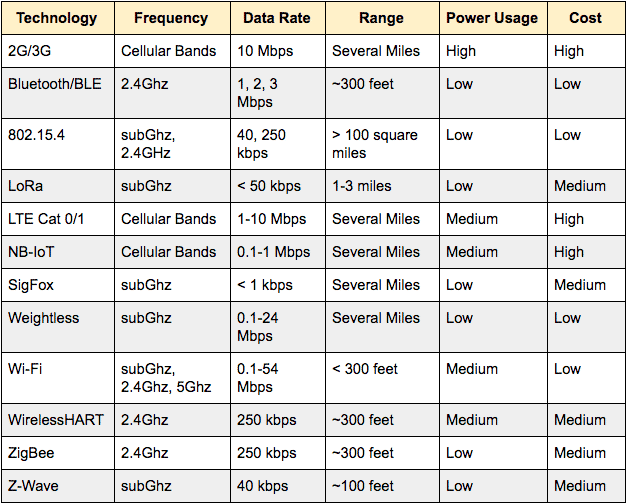
Image Credit: Helium
WirelessHart
"WirelessHART technology provides a robust wireless protocol for the full range of process measurement, control, and asset management applications."
DigiMesh
"DigiMesh is a proprietary peer-to-peer networking topology for use in wireless end-point connectivity solutions.
ISA100.11a
"ISA100.11a is a wireless networking technology standard developed by the International Society of Automation (ISA). The official description is "Wireless Systems for Industrial Automation: Process Control and Related Application"
IEEE 802.15.4
IEEE 802.15.4 is a standard which specifies the physical layer and media access control for low-rate wireless personal area networks (LR-WPANs). It is maintained by the IEEE 802.15 working group. It is the basis for the ZigBee,ISA100.11a, WirelessHART, and MiWi specifications, each of which further extends the standard by developing the upper layers which are not defined in IEEE 802.15.4. Alternatively, it can be used with 6LoWPAN and standard Internet protocols to build a wireless embedded Internet.
NFC
Based on the standard ISO/IEC 18092:2004, using inductive coupled devices at a center frequency of13.56 MHz. The data rate is up to 424 kbps and the rangeis with a few meters short compared to the wireless sensornetworks.
ANT
ANT is a proprietary wireless sensor network technology featuring a wireless communications protocol stack that enables semiconductor radios operating in the 2.4 GHz Industrial, Scientific and Medical allocation of the RF spectrum ("ISM band") to communicate by establishing standard rules for co-existence, data representation, signalling, authentication and error detection.
Bluetooth
Bluetooth works in the 2.4 GHz ISM band and uses frequency hopping. With a data rate up to 3 Mbps and maximum range of 100m. Each application type which can use Bluetooth has its own profile.
Eddystone - A protocol specification that defines a Bluetooth low energy (BLE) message format for proximity beacon messages.
ZigBee
The ZigBee protocol uses the 802.15.4 standard and operates in the 2.4 GHz frequency range with 250 kbps. The maximum number of nodes in the network is 1024 with a range up to 200 meter. ZigBee can use 128 bit AES encryption.
EnOcean
EnOcean is a an energy harvesting wireless technology which works in the frequencies of 868 MHz for europe and 315 MHz for North America. The transmit range goes up to 30 meter in buildings and up to 300 meter outdoor.
WiFi
WiMax
WiMax is based on the standard IEEE 802.16 and is intended for wireless metropolitan area networks. The range is different for fixed stations, where it can go up to 50 km and mobile devices with 5 to 15 km. WiMAx operates at frequencies between 2.5 GHz to 5.8 GHz with a transferrate of 40 Mbps.
LPWAN
Weightless
Weightless is a proposed proprietary open wireless technology standard for exchanging data between a base station and thousands of machines around it (using wavelength radio transmissions in unoccupied TV transmission channels) with high levels of security.
NB-IoT (Narrow-Band IoT) A technology being standardized by the 3GPP standards body
LTE-MTC (LTE-Machine Type Communication) - Standards-based family of technologies supports several technology categories, such as Cat-1 and CatM1, suitable for the IoT.
EC-GSM-IoT (Extended Coverage-GSM-IoT) - Enables new capabilities of existing cellular networks for LPWA (Low Power Wide Area) IoT applications. EC-GSM-IoT can be activated through new software deployed over a very large GSM footprint, adding even more coverage to serve IoT devices.
LoRaWAN - Network protocol intended for wireless battery operated Things in regional, national or global network.
RPMA (Random phase multiple access) A technology communication system employing direct-sequence spread spectrum (DSSS) with multiple access.
Cellular:
GPRS/2G/3G/4G cellular
- View a more complete overview of IoT communication and technologies here.
Semantic
IOTDB
"JSON / Linked Data standards for describing the Internet of Things"
SensorML
"SensorML provides standard models and an XML encoding for describing sensors and measurement processes."
Semantic Sensor Net Ontology - W3C
"This ontology describes sensors and observations, and related concepts. It does not describe domain concepts, time, locations, etc. these are intended to be included from other ontologies via OWL imports."
Wolfram Language - Connected Devices -"A symbolic representation of each device. Then there are a standard set of Wolfram Language functions like DeviceRead, DeviceExecute, DeviceReadBuffer and DeviceReadTimeSeries that perform operations related to the device."
RAML (RESTful API Modeling Language) - Makes it easy to manage the whole API lifecycle from design to sharing. It's concise - you only write what you need to define - and reusable.
SENML (Media Types for Sensor Markup Language) - A simple sensor, such as a temperature sensor, could use this media type in protocols such as HTTP or CoAP to transport the measurements of the sensor or to be configured.
LsDL (Lemonbeat smart Device Language) - XML-based device language for service oriented devices
Multi-layer Frameworks
Alljoyn - An open source software framework that makes it easy for devices and apps to discover and communicate with each other.
IoTivity is an open source project hosted by the Linux Foundation, and sponsored by the OIC.
IEEE P2413 - Standard for an Architectural Framework for the Internet of Things (IoT)
Thread - Built on open standards and IPv6 technology with 6LoWPAN as its foundation.
IPSO Application Framework (PDF)
"This design defines sets of REST interfaces that may be used by a smart object to represent its available resources, interact with other smart objects and backend services. This framework is designed to be complementary to existing Web profiles including SEP2 and oBIX."
OMA LightweightM2M v1.0
"The motivation of LightweightM2M is to develop a fast deployable client-server specification to provide machine to machine service.
LightweightM2M is principly a device management protocol, but it should be designed to be able to extend to meet the requirements of applications. LightweightM2M is not restricted to device management, it should be able transfer service / application data."
Weave - A communications platform for IoT devices that enables device setup, phone-to-device-to-cloud communication, and user interaction from mobile devices and the web.
Telehash - JSON+UDP+DHT=Freedom
A secure wire protocol powering a decentralized overlay network for apps and devices
Security
Open Trust Protocol (OTrP) - A protocol to install, update, and delete applications and to manage security configuration in a Trusted Execution Environment (TEE).
X.509 - Standard for public key infrastructure (PKI) to manage digital certificates and public-key encryption. A key part of the Transport Layer Security protocol used to secure web and email communication.
Vertical Specific
IEEE 1451:
The IEEE 1451, a family of Smart Transducer Interface Standards, describes a set of open, common, network-independent communication interfaces for connecting transducers (sensors or actuators) to microprocessors, instrumentation systems, and control/field networks.
IEEE 1888.3-2013 - “IEEE Standard for Ubiquitous Green Community Control Network: Security”
IEEE 1905.1-2013 - “IEEE Standard for a Convergent Digital Home Network for Heterogeneous Technologies”
IEEE 802.16p-2012 - “IEEE Standard for Air Interface for Broadband Wireless Access Systems”
IEEE 1377-2012 - “IEEE Standard for Utility Industry Metering Communication Protocol Application Layer”
IEEE P1828 - “Standard for Systems With Virtual Components”
IEEE P1856 - “Standard Framework for Prognostics and Health Management of Electronic Systems”
Architectures / Graphic
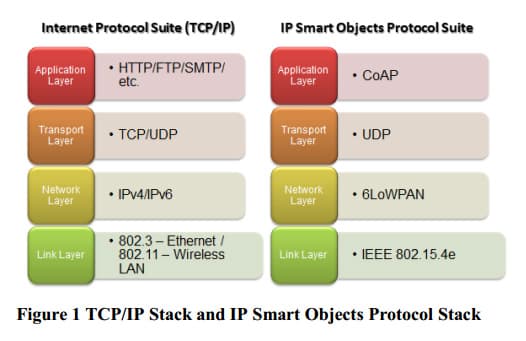
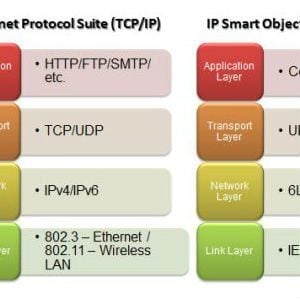
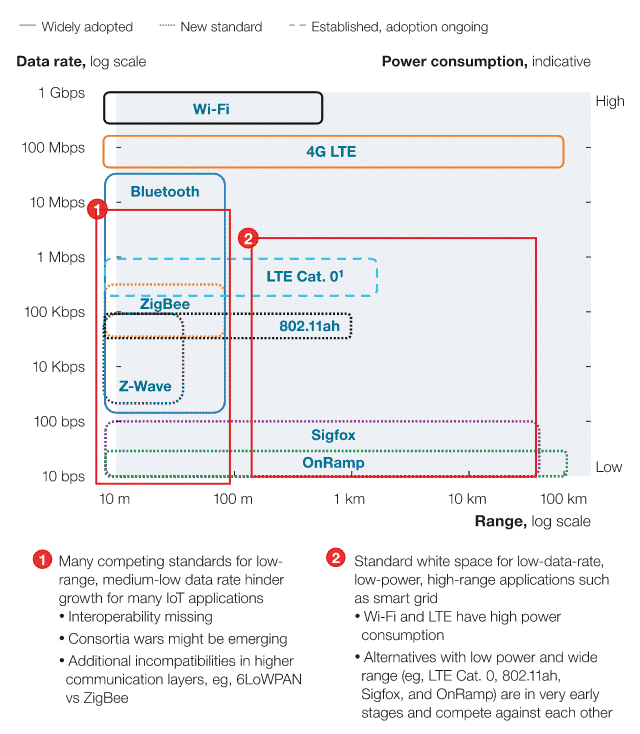
Graphic via Ronak Sutaria and Raghunath Govindachari from Mindtree Labs in "Making sense of interoperability:Protocols and Standardization initiatives in IOT"
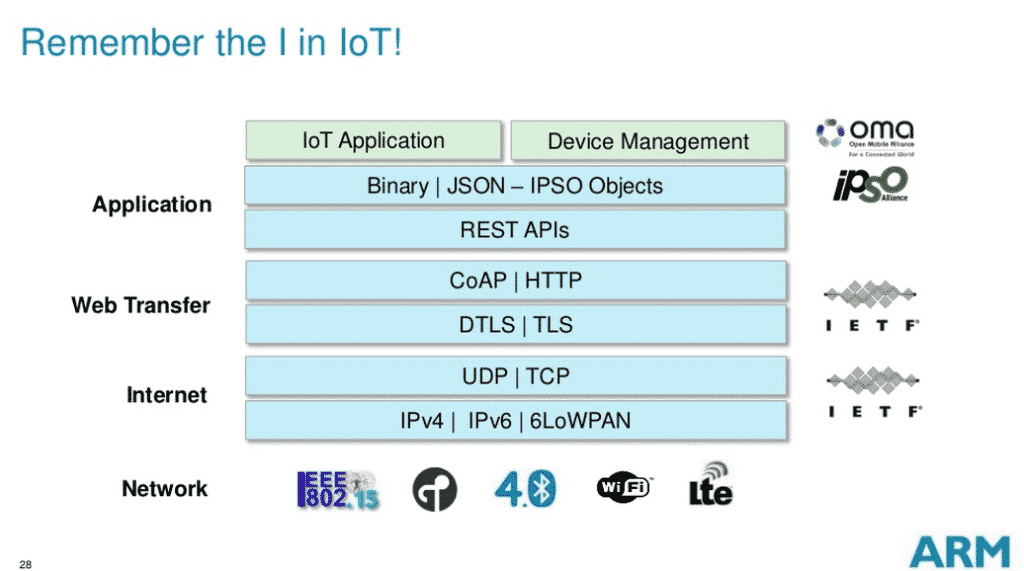
IoT Communication stack from IoT-A Initiative
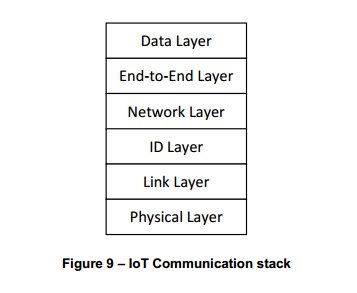
"The communication model aims at defining the main communication paradigms for connecting entities, as defined in the domain model. We provide a reference communication stack, together with insight about the main interactions among the actors in the domain model. We developed a communication stack similar to the ISO OSI 7-layer model for networks, mapping the needed features of the domain model unto communication paradigms. We also describe how communication schemes can be applied to different types of networks in IoT."
- The full reference model presentation can be found here (PDF).
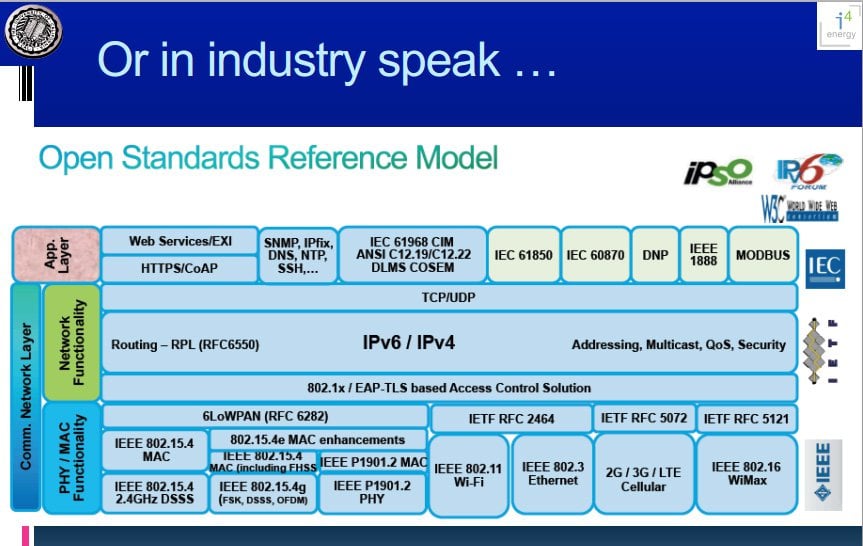
Above Graphic: David E. Culler - The Internet of Every Thing - steps toward sustainability CWSN Keynote, Sept. 26, 2011 (Download PPT)
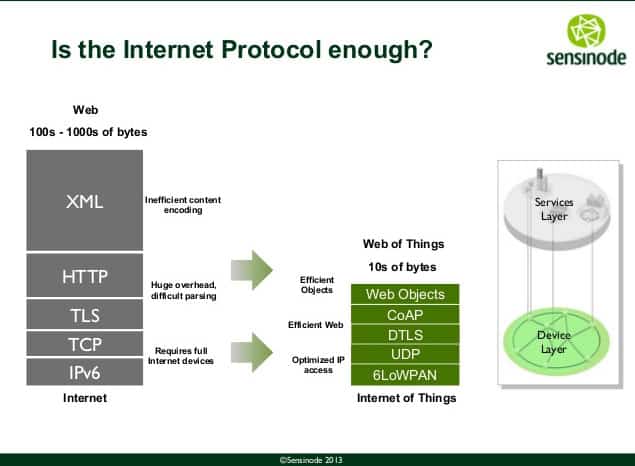
Graphic: Sensinode: - Zach Shelby: Is the Internet Protocol enough? (Full Presentation)
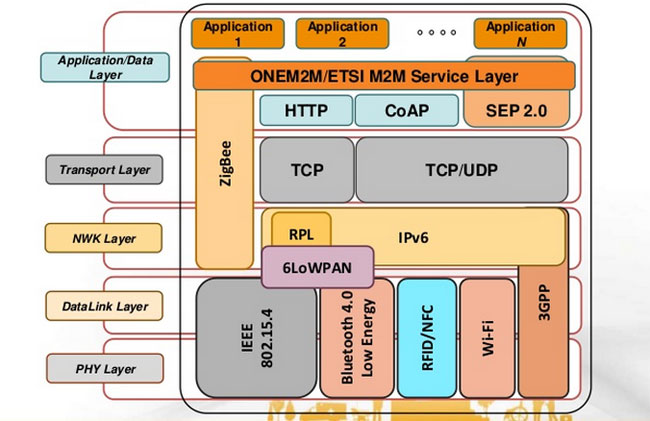
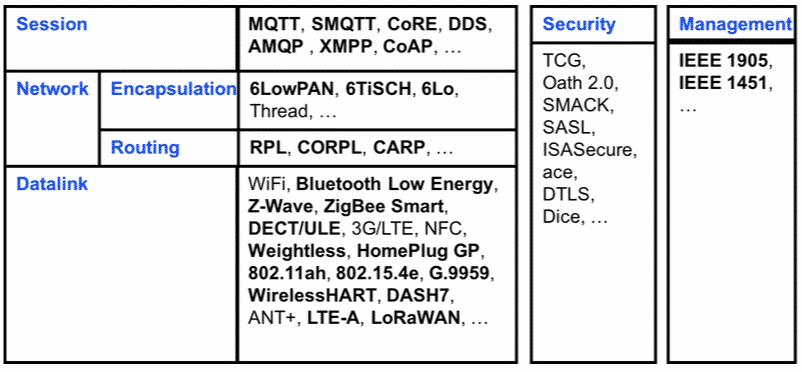
Graphic: Tara Salman
Alliances and Organizations
Organizations:
- ETSI (European Telecommunications Standards Institute)
- Connecting Things Cluster - IETF (Internet Engineering Task Force)
- CoRE working group (Constrained RESTful Environments)
- 6lowpan working group (IPv6 over Low power WPAN)
- ROLL working group (Routing Over Low power and Lossy networks) - IEEE (Institute of Electrical and Electronics Engineers)
- IoT "Innovation Space" - OMG (Object Management Group)
- Data Distribution Service Portal - OASIS (Organization for the Advancement of Structured Information Standards)
- MQTT Technical Committee - OGC (Open Geospatial Consortium)
- Sensor Web for IoT Standards Working Group
- IoT-A
"The European Lighthouse Integrated Project addressing the Internet-of-Things Architecture, proposes the creation of an architectural reference model together with the definition of an initial set of key building blocks."
- OneM2M
"The purpose and goal of oneM2M is to develop technical specifications which address the need for a common M2M Service Layer that can be readily embedded within various hardware and software, and relied upon to connect the myriad of devices in the field with M2M application servers worldwide." - OSIOT
"An organization with the single focus to develop and promote royalty-free, open source standards for the emerging Internet of Things." - IoT-GSI (Global Standards Initiative on Internet of Things)
- ISA International Society of Automation
- W3C
- Semantic Sensor Net Ontology
- Web of Things Community Group - EPC Global
- The IEC (International Electrotechnical Commission), and ISO (International Organization for Standardization), through the JTC (Joint Technical Committee). Committee Page
- RRG (Routing research group)
- HIPRG (Host identity protocol research group)
Eclipse Paho Project
"The scope of the Paho project is to provide open source implementations of open and standard messaging protocols that support current and emerging requirements of M2M integration with Web and Enterprise middleware and applications. It will include client implementations for use on embedded platforms along with corresponding server support as determined by the community."
OpenWSN
"Serves as a repository for open-source implementations of protocol stacks based on Internet of Things standards, using a variety of hardware and software platforms."
CASAGRAS
"We are a key group of international partners representing Europe, the USA, China, Japan and Korea who has joined a strategic EU funded 7th Framework initiative that will look at global standards, regulatory and other issues concerning RFID and its role in realising an “Internet of Things.”
Alliances
AllSeen Alliance
"The AllSeen Alliance is a nonprofit consortium dedicated to enabling and driving the widespread adoption of products, systems and services that support the Internet of Everything with an open, universal development framework supported by a vibrant ecosystem and thriving technical community'
IPSO
"The Alliance is a global non-profit organization serving the various communities seeking to establish the Internet Protocol as the network for the connection of Smart Objects by providing coordinated marketing efforts available to the general public."
Wi-SUN Alliance
The Wi-SUN Alliance seeks to "advance seamless connectivity by promoting IEEE 802.15.4g standard based interoperability for global regional markets."
OMA (Open Mobile Alliance)
"OMA is the Leading Industry Forum for Developing Market Driven, Interoperable Mobile Service Enablers"
- OMA LightweightM2M v1.0
Industrial Internet Consortium
"Founded in 2014 to further development, adoption and wide-spread use of interconnected machines, intelligent analytics and people at work'
More organizations can be found in our IoT technical resources section.
Additional resources
General:
- “Making Sense of Interoperability: IoT Protocols and Standardization Initiatives“, (2013) Sutaria. R. and Govindachari, R
"A number of different standardization bodies and groups are actively working on creating more inter-operable protocol stacks and open standards for the Internet of Things. As we move from the HTTP, TCP, IP stack to the IOT specific protocol stack we are suddenly confronted with an acronym soup of protocols- from the wireless protocols like ZigBee, RFID, Bluetooth and BACnet tonext generation protocol standards such as 802.15.4e, 6LoWPAN, RPL, CoAP etc. which attempt to unify the wireless sensor networks and the established internet."
- "Architecture and protocols for the Internet of Things", (2010) A case study by A P Castellani, N Bui, P Casari, M Rossi, Z Shelby, M Zorzi
- “Standardized Protocol Stack For The Internet Of (Important) Things”, (2012) Maria Rita Palattella, Nicola Accettura, Xavier Vilajosana, Thomas Watteyne, Luigi Alfredo Grieco, Gennaro Boggia and Mischa Dohler.
- "Lightweight IPv6 Stacks for Smart Objects: the Experience of Three Independent and Interoperable Implementations" Internet Protocol for Smart Objects (IPSO) ABy Julien Abeillé, Mathilde Durvy, Jonathan Hui, Stephen Dawson-Haggerty
- "Smart Objects Demand a New Approach to Internet Engineering" By Carolyn Duffy Marsan IETF Journal March 2012
- "Beyond Interoperability – Pushing the Performance of Sensor Network IP Stacks" By JeongGil Ko, Joakim Eriksson, Nicolas Tsiftes, Stephen Dawson-Haggerty, Jean-Philippe Vasseur, Mathilde Durvy, Andreas Terzis, Adam Dunkels and David Culle
- Why IP for Smart Objects? Jean-Philippe Vasseur & Adam Dunkels
- Beyond MQTT: A Cisco View on IoT Protocols - Cisco
- Network Congestion & Lightweight Protocols - Telit
- The Choice Of Protocol For Iot And M2M Will Dictate The Emergence And Success Of The Market - Michael Holdmann
- Standards Drive the Internet of Things - Zach Shelby
- Understanding The Internet Of Things - Ronak Sutaria & Raghunath Govindachari | Electronic Design
- Understanding The Protocols Behind The Internet Of Things (MQTT, XMPP, DDS, AMQP) - Electronic Design
- Messaging Technologies: A Comparison Between DDS, AMQP, MQTT, JMS and REST (PDF) PrismTech
- What a Mesh! Part 2-Networking Architectures and Protocols
- MQTT and CoAP, IoT Protocols - Toby Jaffey
Background Articles
- Semiconductor Engineering: Where Are The IoT Industry Standards? (10/16)
- MQTT and DDS for M2M: Disparate Approaches to the Internet of Things - RTJ
- Building the Internet of Things - DDS vs MQTT Angelo Corsaro
- MQTT Will Enable The Internet Of Things - Andy Stanford-Clark in Electronic Design
- Comparison of MQTT and DDS as M2M Protocols for the Internet of Things - Real Time Innovations
- QEST is a stargate between the universe of devices which speak MQTT, and the universe of apps which speak HTTP and REST.
- Using MQTT to connect Arduino to the Internet of Things - Chris Larson
- Introduction to MQTT (PDF) - Dave Locke
- MQTT and the language of the Internet of Things - Housahedron
- Exploring the Protocols of IoT (MQTT & CoAP) - SparkFun
- Introduction to CoAP the REST protocol for M2M - By Julien Vermillard
- CoAPing with the REST of the Internet of Things - Embedded Software store
- CoAP Tutorial - Zach Shelby
- Wireless Sensor Network Node with REST Advantages: CoAP Protocol - WSN Magazine
- CoAP Course for m2m and Internet of Things scenarios - Carlos Ralli
- Unify to bridge gaps: Bringing XMPP into the Internet of Things (PDf)- Michael Kirsche, Ronny Klauck
- XMPP Service Discovery extensions for M2M and IoT - Servicelab
- A Service Infrastructure for the Internet of Things based on XMPP (PDF) - Sven Bendel, Thomas Springer, Daniel Schuster, Alexander Schill, Ralf Ackermann, Michael Ameling
- Working In The Real World With IoT And XMPP- Rdm For Hvac - Michael Holdmann
- Integrating the Internet of Things with AMQP (PDF) - RedHat
- AMQP and one possible future for messaging - David Goehrig
- RESTful HTTP in practice - Infoq
- Event Models for RESTful APIs - Michael Koster
- The Internet of Things for the REST of us - Bosch
- In Search of an Internet of Things Service Architecture:REST or WS-*? A Developers' Perspective (PDF) - Dominique Guinard, Iulia Ion, and Simon Mayer
LwM2M
See Also: Internet of Things Software, Hardware, Platforms, Definitions